
Sitemap
A list of all the posts and pages found on the site. For you robots out there, there is an XML version available for digesting as well.
Pages
Posts
projects
NavARP Permalink
Published:
 NavARP is an open source python project consisting on a companion application during Angle Resolved Photoemission Spectroscopy experiments, and a set of dedicated libraries for deep data analysis. The application has an interactive user interface for exploring the data, enriched by post-processing procedures (e.g. second derivative, Gaussian and Laplacian filters), giving access to the proper band structure axes (k-vectors, binding energy) after a guided transformation from the data acquisition ones (angles, kinetic energy). The so processed and transformed data can be then exported in different format for its inclusion in publications. The same, and more, functionalities are directly accessible in a python object-oriented library extending the possible data analysis work flow.
Many-body effects in Graphene
Published:
The extreme simplicity of its electronic structure has affirmed graphene as an ideal testbed for the demonstration of many-body effects on band structure. Within this context we have investigated: 1) the isotope substitution as an experimental tool to prove the electron-phonon coupling origin of sudden band slope change (known as kink) near the Fermi level; 2) highly doped graphene reaching almost the van-Hove singularity, to demonstrate that its apparent band flattening is just the unoccupied band spectral functional tails. 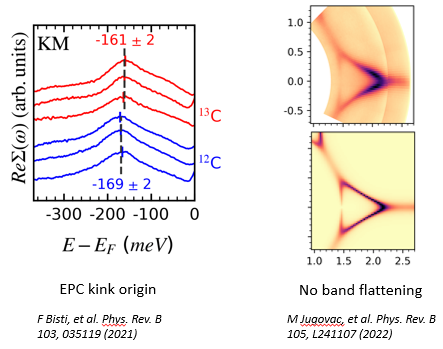
TOTEM: engineering TOpological quantum phases in hexagonal TErnary coMpounds
Published:
Material hosting quasiparticles acting as Weyl or Dirac fermions offer unique quantum phenomena which could be exploited in a completely new generation of electronic device. These materials are in general called topological semimetals, which differentiate from the topological insulator by hosting directly in the bulk band structure massless excitations, and not only at the surface. In this ongoing project we are characterizing different compounds with aim to discover new topological semimetals and explore the possible tunability of their topological phase by alloy engineering.
SHEEP: Symmetry-broken HEterostructurEs for Photovoltaic applications Permalink
Published:
 The idea behind the SHEEP project is to use novel 2D heterostructures that will exhibit the Bulk Photovoltaic Effect (BVPE). Indeed, a “shift current” (the relevant parameter for BPVE generation) occurs every time the real-space centre of charge for valence bands differs from the centre of charge for conduction bands, the results is a photocurrent from the spatial displacement of electrons and holes during light-induced transitions. The SHEEP project is based on a combined theoretical and experimental approach. The engineering of 2D heterostructures will be performed with the use of state-of-the-art computational codes based on density functional theory with advanced functionals, and using the low energy model framework. The SHEEP interfaces will be fabricated via mechanical exfoliation and lift-of and transfer techniques and then further studied with on campus (Raman, PL, STM/STS) and state of the synchrotron radiation tools like micro-ARPES. The project is funded by the European Union – NextGenerationEU (component M4C2, investment 1.1) through the “Ministero dell’Università e della Ricerca” within the program “progetti di ricerca di rilevante interesse nazionale” (PRIN) for the two-year period 2023/2025.
publications
Local surface morphology and chemistry of SnO2 thin films deposited by rheotaxial growth and thermal oxidation method for gas sensor application
Published in Thin Solid Films, 2009
In this paper experimental results of a comparative X-ray Diffraction (XRD), Scanning Electron Microscopy (SEM), Atomic Force Microscopy (AFM) and X-ray Photoelectron Spectroscopy (XPS) study of the crystalline structure, the local morphology, and the surface and in-depth chemistry of SnO2 thin films obtained by Rheotaxial Growth and Thermal Oxidation (RGTO) method are presented. XRD rules out even a minor presence of a coexisting SnO phase. AFM and SEM show a fractal like morphology of nanograins (20 nm typical size) agglomerated in clusters of crystallites with a bimodal size distribution. XPS shows that the surface of the SnO2 crystallites is slightly under-stoichiometric as expected from the oxygen deficient termination of their facets. Noteworthy, as evidenced by XPS depth profiles, there are no significant changes of the surface chemistry of the RGTO film with argon ion sputtering. © 2009 Elsevier B.V. All rights reserved.
Recommended citation: L. Ottaviano, M. Kwoka, F. Bisti, P. Parisse, V. Grossi, S. Santucci, J. Szuber, "Local surface morphology and chemistry of SnO2 thin films deposited by rheotaxial growth and thermal oxidation method for gas sensor application." Thin Solid Films 22, 6161-6169, (2009).
Download Paper
Infrared photoluminescence of erbium-tris(8-hydroxyquinoline) in a distributed feedback cavity
Published in Journal of Luminescence, 2011
A distributed feedback (DFB) waveguide cavity with erbium-tris(8- hydroxyquinoline) has been fabricated by X-ray interference lithography in a laboratory-scale apparatus. The DFB cavity consists of a large area (∼8mm2) one-dimensional grating of polymethylmethacrylate on Si (1 0 0). Structural, morphological and optical properties of the device have been studied. On-grating narrowing of the photoluminescence emission has been observed for the 492 nm grating period in correspondence to the 4f4f Er band peak (at 1530 nm), indicating the possibility of optical gain for applications in the telecommunications. © 2010 Elsevier B.V.
Recommended citation: S. Prezioso, L. Ottaviano, F. Bisti, M. Donarelli, S. Santucci, L. Palladino, S. Penna, A. Reale, "Infrared photoluminescence of erbium-tris(8-hydroxyquinoline) in a distributed feedback cavity." Journal of Luminescence 4, 682-685, (2011).
Bulk phase two dimensional chiral growth of 6, 13 Pentacenequinone on SiO 2
Published in Journal of Applied Physics, 2011
6,13 Pentacenequinone (PQ) ultrathin films (3 and 5 nm nominal thickness) have been grown by means of ultrahigh vacuum deposition onto 100 nm thick SiO2/Si(100). The structure and morphology of the thin films have been studied with field emission-scanning electron microscopy, tapping mode atomic force microscopy, and x-ray diffraction. The growth begins with PQ molecules standing almost upright (with respect to the substrate) and aggregating into two-dimensional 3.62 nm thick pseudodendritic islands. The islands are characterized by two preferential growth directions (at 117°), a clear evidence of a chiral growth. The thickness of the islands and the angle formed by the two directions of preferential growth, allow a straightforward assignment to a PQ initial growth in the “bulk” phase. Above the critical thickness of 3.62 nm the PQ growth proceeds in a Stranski−Krastanov mode, with the formation of “bulk” and “thin-film” phase crystallites.
Recommended citation: P. Marco, F. Fioriti, F. Bisti, P. Parisse, S. Santucci, L. Ottaviano, "Bulk phase two dimensional chiral growth of 6, 13 Pentacenequinone on SiO 2." Journal of Applied Physics 6, 063508, (2011).
Download Paper
Fingerprints of the hydrogen bond in the photoemission spectra of croconic acid condensed phase: An x-ray photoelectron spectroscopy and ab-initio study
Published in The Journal of Chemical Physics, 2011
The electronic structure of Croconic Acid in the condensed phase has been studied by comparing core level and valence band x-ray photoelectron spectroscopy experiments and first principles density functional theory calculations using the Heyd-Scuseria-Ernzerhof screened hybrid functional and the GW approximation. By exploring the photoemission spectra for different deposition thicknesses, we show how the formation of the hydrogen bond network modifies the O 1s core level lineshape. Moreover, the valence band can be explained only if the intermolecular interactions are taken into account in the theoretical approach.
Recommended citation: F. Bisti, A. Stroppa, S. Picozzi, L. Ottaviano, "Fingerprints of the hydrogen bond in the photoemission spectra of croconic acid condensed phase: An x-ray photoelectron spectroscopy and ab-initio study." The Journal of Chemical Physics 17, 174505, (2011).
Download Paper
Electronic structure of tris(8-hydroxyquinolinato)aluminium(III) revisited using the Heyd-Scuseria-Ernzerhof hybrid functional: Theory and experiments
Published in Physical Review B, 2011
The electronic properties of tris(8-hydroxyquinolinato)aluminium(III) (AlQ(3)) have been revisited using the screened hybrid Heyd-Scuseria-Ernzerhof density functional theory. We show that such approach very well accounts for the experimental occupied (valence band spectrum) and unoccupied (inverse photoemission spectrum) states. Furthermore, the density of states projected onto nitrogen, oxygen, and carbon are compared with soft x-ray adsorption and emission spectroscopy, showing a very good agreement between theory and experiments. Finally, a fully theoretical interpretation of the carbon 1s core level is proposed.
Recommended citation: F. Bisti, A. Stroppa, M. Donarelli, S. Picozzi, L. Ottaviano, "Electronic structure of tris(8-hydroxyquinolinato)aluminium(III) revisited using the Heyd-Scuseria-Ernzerhof hybrid functional: Theory and experiments." Physical Review B 19, 195112, (2011).
Download Paper
Large Area Extreme-UV Lithography of Graphene Oxide via Spatially Resolved Photoreduction
Published in Langmuir, 2012
The ability to pattern graphene over large areas with nanometer resolution is the current request for nanodevice fabrication at the industrial scale. Existing methods do not match high throughput with nanometer resolution. We propose a high-throughput resistless extreme-UV (EUV) photolithographic approach operating with sub-micrometer resolution on large area (∼10 mm2) graphene oxide (GO) films via spatially resolved photoreduction. The efficiency of EUV photoreduction is tested with 46.9 nm coherent light produced by a table top capillary discharge plasma source. Irradiated samples are studied by X-ray photoemission spectroscopy (XPS) and micro-Raman Spectroscopy (μRS). XPS data show that 200 mJ/cm2 EUV dose produces, onto pristine GO, a 6% increase of sp2 carbon bonds and a 20% decrease of C–O bonds. μRS data demonstrate a photoreduction efficiency 2 orders of magnitude higher than the one reported in the literature for UV-assisted photoreduction. GO patterning is obtained modulating the EUV dose with a…
Recommended citation: S. Prezioso, F. Perrozzi, M. Donarelli, F. Bisti, S. Santucci, L. Palladino, M. Nardone, E. Treossi, V. Palermo, L. Ottaviano, "Large Area Extreme-UV Lithography of Graphene Oxide via Spatially Resolved Photoreduction." Langmuir 12, 5489-5495, (2012).
Download Paper
Combined microscopies study of the C-contamination induced by extreme-ultraviolet radiation: A surface-dependent secondary-electron-based model
Published in Applied Physics Letters, 2012
SiO2 and Al2O3 surfaces exposed to periodically modulated extreme ultraviolet (EUV) light (λ = 46.9 nm) have been investigated at the μm scale by optical microscopy, scanning electron microscopy, scanning Auger microscopy, atomic force microscopy, and Kelvin probe force microscopy. The formation of a carbon contamination layer preserving the same periodical modulation of the EUV dose has been observed. The mechanisms of hydrocarbon molecules deposition have been studied with the help of correlation plots between the modulated Auger signal and the corresponding EUV dose. A surface-dependent secondary-electron-based model has been proposed.
Recommended citation: S. Prezioso, M. Donarelli, F. Bisti, L. Palladino, S. Santucci, S. Spadoni, L. Avaro, A. Liscio, V. Palermo, L. Ottaviano, "Combined microscopies study of the C-contamination induced by extreme-ultraviolet radiation: A surface-dependent secondary-electron-based model." Applied Physics Letters 20, 201603, (2012).
Download Paper
Crystal phase dependent photoluminescence of 6,13-pentacenequinone
Published in Journal of Applied Physics, 2012
Films of 6,13-pentacenequinone (PQ, C22H12O2) of nominal thicknesses 5 and 30 nm grown in high vacuum onto SiO2 have been UV (325 nm) excited and their photoluminescence (PL) response has been investigated with the support of parallel scanning electron microscopy (FE-SEM) and x-ray diffraction (XRD) experiments. The photoluminescence spectra typically show a multiplet structure that can be ultimately assigned to the sum of the emission spectra from two different crystal phases, namely the “bulk” and the “thin film” phase, emitting respectively in the 500–600 nm and 600–750 nm spectral ranges. The assignment is done via the systematic parallel SEM and XRD investigation of the samples. Data are also discussed in comparison with PL spectra of PQ reported in the literature. The blue shift of the “bulk” phase PL spectrum is assigned to its smaller (about 9% less than in the “thin film” phase) molecular packing density in the ab-plane, and accordingly, to a decreased π–π orbital overlap.
Recommended citation: P. Marco, F. Bisti, F. Fioriti, M. Passacantando, C. Bittencourt, S. Lettieri, A. Ambrosio, P. Maddalena, S. Prezioso, S. Santucci, L. Ottaviano, "Crystal phase dependent photoluminescence of 6,13-pentacenequinone." Journal of Applied Physics 1, 013512, (2012).
Download Paper
Unravelling the Role of the Central Metal Ion in the Electronic Structure of Tris(8-hydroxyquinoline) Metal Chelates: Photoemission Spectroscopy and Hybrid Functional Calculations
Published in The Journal of Physical Chemistry A, 2012
The electronic structures of tris(8-hydroxyquinolinato)–erbium(III) (ErQ3) and tris(8-hydroxyquinolinato)–aluminum(III) (AlQ3) have been studied by means of core level and valence band photoemission spectroscopy with the theoretical support of hybrid Heyd–Scuseria–Ernzerhof density functional theory, to investigate the role played by the central metal atom. A lower binding energy (0.2 eV and 0.3 eV, respectively) of the O 1s and N 1s core levels has been observed for ErQ3 with respect to AlQ3. Differences in the valence band spectra, mainly related to the first two peaks next to the highest occupied molecular orbital (HOMO), have been ascribed to an energetic shift (to 0.4 eV lower energies for ErQ3) of the σ molecular orbital between the oxygen atoms and the central metal atom. A lower (by 0.5 eV) ionization energy has been measured for the ErQ3. The interpretation of these results is based on a reduced interaction between the central metal atom and the ligands in ErQ3, with increased electronic charge a…
Recommended citation: F. Bisti, A. Stroppa, M. Donarelli, G. Anemone, F. Perrozzi, S. Picozzi, L. Ottaviano, "Unravelling the Role of the Central Metal Ion in the Electronic Structure of Tris(8-hydroxyquinoline) Metal Chelates: Photoemission Spectroscopy and Hybrid Functional Calculations." The Journal of Physical Chemistry A 47, 11548-11552, (2012).
Download Paper
The electronic structure of gas phase croconic acid compared to the condensed phase: More insight into the hydrogen bond interaction
Published in The Journal of Chemical Physics, 2013
The electronic structure of croconic acid in the gas phase has been investigated by means of core level and valence band photoemission spectroscopy and compared with hybrid Heyd-Scuseria-Ernzerhof density functional theory calculations. The results have been compared with the corresponding ones of the condensed phase. In the gas phase, due to the absence of hydrogen bond intermolecular interactions, the O 1 s core level spectrum shows a shift of binding energy between the hydroxyl (O–H) and the carbonyl group (C=O) of 2.1 eV, which is larger than the condensed phase value of 1.6 eV. Interestingly, such a shift decreases exponentially with the increase of the O–H distance calculated from theory. The significant differences between the gas and condensed phase valence band spectra highlight the important role played by the hydrogen bonding in shaping the electronic structure of the condensed phase.
Recommended citation: F. Bisti, A. Stroppa, F. Perrozzi, M. Donarelli, S. Picozzi, M. Coreno, M. Simone, K. Prince, L. Ottaviano, "The electronic structure of gas phase croconic acid compared to the condensed phase: More insight into the hydrogen bond interaction." The Journal of Chemical Physics 1, 014308, (2013).
Download Paper
Use of Optical Contrast To Estimate the Degree of Reduction of Graphene Oxide
Published in The Journal of Physical Chemistry C, 2013
We report an optical contrast study of graphene oxide on 72 nm Al2O3/Si(100) and 300 nm SiO2/Si(100) as a function of its reduction degree. The reduction has been performed by means of ultrahigh vacuum thermal annealing from 25 °C (pristine graphene oxide) to 670 °C. In parallel to the optical contrast investigation, performed with optical microscopy, the graphene oxide films have been characterized with core level X-ray photoemission spectroscopy and micro-Raman spectroscopy. The optical contrast of graphene oxide (normalized to the one measured for pure graphene) on both substrates ranges from ∼0.4 to 1.0 for pristine and 670 °C annealed graphene oxide, respectively. Optical microscopy and X-ray photoemission spectroscopy data have been cross-correlated, leading to calibration graphs that demonstrate that just by simply measuring the optical contrast of graphene oxide one can determine with very good approximation the fraction of sp2 hybridized carbon.
Recommended citation: F. Perrozzi, S. Prezioso, M. Donarelli, F. Bisti, P. Marco, S. Santucci, M. Nardone, E. Treossi, V. Palermo, L. Ottaviano, "Use of Optical Contrast To Estimate the Degree of Reduction of Graphene Oxide." The Journal of Physical Chemistry C 1, 620-625, (2013).
Download Paper
Tetrakis erbium quinolinate complexes, electronic structure investigation
Published in Organic Electronics, 2014
The electronic structures of three new synthesised tetrakis Erbium(III) quinolinate complexes (Na[ErQ4], Na[Er(Q57Br)4] and Na[Er(Q57I)4]) have been studied by means of photoemission and absorption spectroscopies and compared with corresponding experimental data of Tris(8-hydroxyquinolinate)Erbium(III) (ErQ3). Core level and valence band spectra of Na[ErQ4] are very similar to ErQ3 ones apart from a slight modification in the O 1s core level. The fundamental physical parameters for optical device applications as ionization energy and optical gap are the same, corresponding to 5.2 eV and 2.9 eV respectively. For the other two molecules, the introduction of halogens (Br, I) in the ligands leads to a reduction of 0.2 eV for the optical gap and to an increase of 0.5 eV for the ionization energy with respect to ErQ3. ?? 2014 Elsevier B.V. All rights reserved.
Recommended citation: F. Bisti, G. Anemone, M. Donarelli, S. Penna, A. Reale, L. Ottaviano, "Tetrakis erbium quinolinate complexes, electronic structure investigation." Organic Electronics 8, 1810-1814, (2014).
Download Paper
Electronic and geometric structure of graphene/SiC(0001) decoupled by lithium intercalation
Published in Physical Review B, 2015
Graphene formation on top of SiC(0001) by decoupling the carbon buffer layer through lithium intercalation is investigated. Low-energy electron diffraction and core-level photoemission spectroscopy results show that graphene formation already occurs at room temperature, and that the interface morphology is improved after thermal annealing. Angle-resolved photoemission spectroscopy (ARPES) shows that the resulting graphene layer is strongly n-type doped, and in spite of the decoupling by lithium intercalation, a persistent interaction with the substrate imposes a superperiodicity on the graphene band structure that modulates the π band intensity and gives rise to quasi-(2×2) π replica bands. Through a comparison of the ARPES-derived band structure with density-functional-theory calculations, we assign the observed bands to SiC-derived states and interface-related ones; this assignment permits us to establish that the intercalated lithium occupies the T4 site on the topmost SiC layer.
Recommended citation: F. Bisti, G. Profeta, H. Vita, M. Donarelli, F. Perrozzi, P. Sheverdyaeva, P. Moras, K. Horn, L. Ottaviano, "Electronic and geometric structure of graphene/SiC(0001) decoupled by lithium intercalation." Physical Review B 24, 245411, (2015).
Download Paper
Few layered MoS 2 lithography with an AFM tip: description of the technique and nanospectroscopy investigations
Published in Nanoscale, 2015
A novel technique to lithograph the MoS2 surface is described here. Mechanically exfoliated MoS2 flakes have been patterned with an atomic force microscope tip. After the patterning process, the lithographed areas have been removed by selective chemical etching. The electronic properties of the MoS2 flakes have been analyzed with spatially resolved photoelectron spectroscopy, with tunable incident photon energy, provided by a synchrotron light source. Tens of meV core level shifts can be recorded in relation to the flakes edges, coming from both the exfoliation and from the lithography.
Recommended citation: M. Donarelli, F. Perrozzi, F. Bisti, F. Paparella, V. Feyer, A. Ponzoni, M. Gonchigsuren, L. Ottaviano, "Few layered MoS 2 lithography with an AFM tip: description of the technique and nanospectroscopy investigations." Nanoscale 26, 11453-11459, (2015).
Download Paper
Observation of Weyl nodes in TaAs
Published in Nature Physics, 2015
In 1929, H. Weyl proposed that the massless solution of Dirac equation represents a pair of new type particles, the so-called Weyl fermions [1]. However the existence of them in particle physics remains elusive for more than eight decades. Recently, significant advances in both topological insulators and topological semimetals have provided an alternative way to realize Weyl fermions in condensed matter as an emergent phenomenon: when two non-degenerate bands in the three-dimensional momentum space cross in the vicinity of Fermi energy (called as Weyl nodes), the low energy excitation behaves exactly the same as Weyl fermions. Here, by performing soft x-ray angle-resolved photoemission spectroscopy measurements which mainly probe bulk band structure, we directly observe the long-sought-after Weyl nodes for the first time in TaAs, whose projected locations on the (001) surface match well to the Fermi arcs, providing undisputable experimental evidence of existence of Weyl fermion quasiparticles in TaAs.
Recommended citation: B. Lv, N. Xu, H. Weng, J. Ma, P. Richard, X. Huang, L. Zhao, G. Chen, C. Matt, F. Bisti, V. Strocov, J. Mesot, Z. Fang, X. Dai, T. Qian, M. Shi, H. Ding, "Observation of Weyl nodes in TaAs." Nature Physics 9, 724-727, (2015).
Download Paper
Fermi states and anisotropy of Brillouin zone scattering in the decagonal Al–Ni–Co quasicrystal
Published in Nature Communications, 2015
Quasicrystals (QCs) are intermetallic alloys that have excellent long-range order but lack translational symmetry in at least one dimension. The valence band electronic structure near the Fermi energy EF in such materials is of special interest since it has a direct relation to their unusual physical properties. However, the Fermi surface (FS) topology as well as the mechanism of QC structure stabilization are still under debate. Here we report the first observation of the three-dimensional FS and valence band dispersions near EF in decagonal Al70Ni20Co10 (d-AlNiCo) QCs using soft X-ray angle-resolved photoemission spectroscopy. We show that the FS, formed by dispersive Al sp-states, has a multicomponent character due to a large contribution from high-order bands. Moreover, we discover that the magnitude of the gap at the FS related to the interaction with Brillouin zone boundary (Hume-Rothery gap) critically differs for the periodic and quasiperiodic directions.
Recommended citation: V. Rogalev, O. Gröning, R. Widmer, J. Dil, F. Bisti, L. Lev, T. Schmitt, V. Strocov, "Fermi states and anisotropy of Brillouin zone scattering in the decagonal Al–Ni–Co quasicrystal." Nature Communications 1, 8607, (2015).
Download Paper
Observation of Weyl nodes and Fermi arcs in tantalum phosphide
Published in Nature Communications, 2016
Weyl fermions are two-component spinors described by irreducible representations of the Lorentz group. They are massless with well-defined helicity and move with the speed of light. Although such kind of elementary particles have not been found yet in real space, the charge excitations in a certain class of materials, the Weyl semimetals, are predicted to behave exactly the same as the Weyl fermions, leading to exotic properties like chiral anomaly and quantum anomalous Hall effect. Carrying out angle-resolved photoemission spectroscopy on TaP, a Weyl semimetal candidate, in a wide photon energy range, we observed the pairs of Weyl cones in the bulk electronic states and the unclosed Fermi arcs on the Ta-terminated surface, which fully agree with theoretical calculations. Our results unambiguously establish that TaP is a Weyl semimetal with one type of well-separated Weyl nodes locates at the chemical potential, which guarantee that the exotic low-energy excitations near the Weyl nodes dominate the transport properties, and may lead to novel applications in this nontoxic transition metal monophosphide.
Recommended citation: N. Xu, H. Weng, B. Lv, C. Matt, J. Park, F. Bisti, V. Strocov, D. Gawryluk, E. Pomjakushina, K. Conder, N. Plumb, M. Radovic, G. Autès, O. Yazyev, Z. Fang, X. Dai, T. Qian, J. Mesot, H. Ding, M. Shi, "Observation of Weyl nodes and Fermi arcs in tantalum phosphide." Nature Communications 1, 11006, (2016).
Download Paper
<math display="inline"> NaFe 0.56 Cu 0.44 As </math> : A Pnictide Insulating Phase Induced by On-Site Cou
Published in Physical Review Letters, 2016
In the studies of iron-pnictides, a key question is whether their bad-metal state from which the superconductivity emerges lies in close proximity with a magnetically ordered insulating phase. Recently it was found that at low temperatures, the heavily Cu-doped NaFe${1-x}$Cu$_x$As ($x > 0.3$) iron-pnictide is an insulator with long-range antiferromagnetic order, similar to the parent compound of cuprates but distinct from all other iron-pnictides. Using angle-resolved photoemission spectroscopy, we determined the momentum-resolved electronic structure of NaFe${1-x}$Cu$x$As ($x = 0.44$) and identified that its ground state is a narrow-gap insulator. Combining the experimental results with density functional theory (DFT) and DFT+U calculations, our analysis reveals that the on-site Coulombic (Hubbard) and Hund’s coupling energies play crucial roles in formation of the band gap about the chemical potential. We propose that at finite temperatures charge carriers are thermally excited from the Cu-As-like valence band into the conduction band, which is of Fe $3d$-like character. With increasing temperature, the number of electrons in the conduction band becomes larger and the hopping energy between Fe sites increases, and finally the long-range antiferromagnetic order is destroyed at $T > T\mathrm{N}$. Our study provides a basis for investigating the evolution of the electronic structure of a Mott insulator transforming into a bad metallic phase, and eventually forming a superconducting state in iron-pnictidesa superconducting state in iron-pnictides.
Recommended citation: C. Matt, N. Xu, B. Lv, J. Ma, F. Bisti, J. Park, T. Shang, C. Cao, Y. Song, A. Nevidomskyy, P. Dai, L. Patthey, N. Plumb, M. Radovic, J. Mesot, M. Shi, "<math display="inline">
Download Paper
Disentangling bulk and surface Rashba effects in ferroelectric -GeTe
Published in Physical Review B, 2016
Macroscopic ferroelectric order in α-GeTe with its noncentrosymmetric lattice structure leads to a giant Rashba spin splitting in the bulk bands due to strong spin-orbit interaction. Direct measure- ments of the bulk band structure using soft x-ray angle-resolved photoemission (ARPES) reveales the three-dimensional electronic structure with spindle torus shape. By combining high-resolution and spin-resolved ARPES as well as photoemission calculations, the bulk electronic structure is dis- entangled from the two-dimensional surface electronic structure by means of surface capping, which quenches the complex surface electronic structure. This unravels the bulk Rashba-split states in the ferroelectric Rashba α-GeTe(111) semiconductor exhibiting a giant spin-splitting with Rashba parameter αR around 4.2 eV/˚ A, the highest of so-far known materials.
Recommended citation: J. Krempaský, H. Volfová, S. Muff, N. Pilet, G. Landolt, M. Radović, M. Shi, D. Kriegner, V. Holý, J. Braun, H. Ebert, F. Bisti, V. Rogalev, V. Strocov, G. Springholz, J. Minár, J. Dil, "Disentangling bulk and surface Rashba effects in ferroelectric -GeTe." Physical Review B 20, 205111, (2016).
Download Paper
Entanglement and manipulation of the magnetic and spin–orbit order in multiferroic Rashba semiconductors
Published in Nature Communications, 2016
Entanglement of the spin-orbit and magnetic order in multiferroic materials bears a strong potential for engineering novel electronic and spintronic devices. Here, we explore the electron and spin structure of ferroelectric α-GeTe thin films doped with ferromagnetic Mn impurities to achieve its multiferroic functionality. We use bulk-sensitive soft-X-ray angle-resolved photoemission spectroscopy (SX-ARPES) to follow hybridization of the GeTe valence band with the Mn dopants. We observe a gradual opening of the Zeeman gap in the bulk Rashba bands around the Dirac point with increase of the Mn concentration, indicative of the ferromagnetic order, at persistent Rashba splitting. Furthermore, subtle details regarding the spin-orbit and magnetic order entanglement are deduced from spin-resolved ARPES measurements. We identify antiparallel orientation of the ferroelectric and ferromagnetic polarization, and altering of the Rashba-type spin helicity by magnetic switching. Our experimental results are supported by first-principles calculations of the electron and spin structure.
Recommended citation: J. Krempaský, S. Muff, F. Bisti, M. Fanciulli, H. Volfová, A. Weber, N. Pilet, P. Warnicke, H. Ebert, J. Braun, F. Bertran, V. Volobuev, J. Minár, G. Springholz, J. Dil, V. Strocov, "Entanglement and manipulation of the magnetic and spin–orbit order in multiferroic Rashba semiconductors." Nature Communications 1, 13071, (2016).
Download Paper
Electronic structure of buried LaNiO3 layers in (111)-oriented LaNiO3/LaMnO3 superlattices probed by soft x-ray ARPES
Published in APL Materials, 2017
Taking advantage of the large electron escape depth of soft x-ray angle resolved photoemission spectroscopy, we report electronic structure measurements of (111)-oriented [LaNiO3/LaMnO3] superlattices and LaNiO3 epitaxial films. For thin films, we observe a 3D Fermi surface with an electron pocket at the Brillouin zone center and hole pockets at the zone vertices. Superlattices with thick nickelate layers present a similar electronic structure. However, as the thickness of the LaNiO3 is reduced, the superlattices become insulating. These heterostructures do not show a marked redistribution of spectral weight in momentum space but exhibit a pseudogap of ≈50 meV.
Recommended citation: F. Bruno, M. Gibert, S. Walker, O. Peil, A. Torre, S. Riccò, Z. Wang, S. Catalano, A. Tamai, F. Bisti, V. Strocov, J. Triscone, F. Baumberger, "Electronic structure of buried LaNiO3 layers in (111)-oriented LaNiO3/LaMnO3 superlattices probed by soft x-ray ARPES." APL Materials 1, 016101, (2017).
Download Paper
Band structure of the EuO/Si interface: justification for silicon spintronics
Published in Journal of Materials Chemistry C, 2017
The band offset of 1.0 eV at the EuO/Si interface attests the technological potential of the system for silicon spintronics.
Recommended citation: L. Lev, D. Averyanov, A. Tokmachev, F. Bisti, V. Rogalev, V. Strocov, V. Storchak, "Band structure of the EuO/Si interface: justification for silicon spintronics." Journal of Materials Chemistry C 1, 192-200, (2017).
Download Paper
Electronic band structure of the buried SiO2/SiC interface investigated by soft x-ray ARPES
Published in Applied Physics Letters, 2017
© 2017 Author(s). The electronic structure of the SiO 2 /SiC (0001) interface, buried below SiO 2 layers with a thickness from 2 to 4 nm, was explored using soft X-ray angle-resolved photoemission spectroscopy with photon energies between 350 and 1000 eV. The measurements have detected the characteristic k-dispersive energy bands of bulk Silicon Carbide (SiC) below the SiO 2 layer without any sign of additional dispersive states, up to an estimated instrumental sensitivity of ≈5 × 10 9 cm 2 eV. This experimental result supports the physical picture that the large density of interface traps observed in macroscopic measurements results from dangling bonds randomized by the SiO 2 rather than from Shockley-Tamm surface derived states extending into the bulk SiC.
Recommended citation: J. Woerle, F. Bisti, M. Husanu, V. Strocov, C. Schneider, H. Sigg, J. Gobrecht, U. Grossner, M. Camarda, "Electronic band structure of the buried SiO2/SiC interface investigated by soft x-ray ARPES." Applied Physics Letters 13, 132101, (2017).
Download Paper
Distinct Evolutions of Weyl Fermion Quasiparticles and Fermi Arcs with Bulk Band Topology in Weyl Semimetals
Published in Physical Review Letters, 2017
The Weyl semimetal phase is a recently discovered topological quantum state of matter characterized by the presence of topologically protected degeneracies near the Fermi level. These degeneracies are the source of exotic phenomena, including the realization of chiral Weyl fermions as quasiparticles in the bulk and the formation of Fermi arc states on the surfaces. Here, we demonstrate that these two key signatures show distinct evolutions with the bulk band topology by performing angle-resolved photoemission spectroscopy, supported by first-principle calculations, on transition-metal monophosphides. While Weyl fermion quasiparticles exist only when the chemical potential is located between two saddle points of the Weyl cone features, the Fermi arc states extend in a larger energy scale and are robust across the bulk Lifshitz transitions associated with the recombination of two non-trivial Fermi surfaces enclosing one Weyl point into a single trivial Fermi surface enclosing two Weyl points of opposite chirality. Therefore, in some systems (e.g. NbP), topological Fermi arc states are preserved even if Weyl fermion quasiparticles are absent in the bulk. Our findings not only provide insight into the relationship between the exotic physical phenomena and the intrinsic bulk band topology in Weyl semimetals, but also resolve the apparent puzzle of the different magneto-transport properties observed in TaAs, TaP and NbP, where the Fermi arc states are similar.
Recommended citation: N. Xu, G. Autès, C. Matt, B. Lv, M. Yao, F. Bisti, V. Strocov, D. Gawryluk, E. Pomjakushina, K. Conder, N. Plumb, M. Radovic, T. Qian, O. Yazyev, J. Mesot, H. Ding, M. Shi, "Distinct Evolutions of Weyl Fermion Quasiparticles and Fermi Arcs with Bulk Band Topology in Weyl Semimetals." Physical Review Letters 10, 106406, (2017).
Download Paper
Direct observation of how the heavy-fermion state develops in CeCoIn5
Published in Physical Review B, 2017
© 2017 American Physical Society. Heavy-fermion systems share some of the strange metal phenomenology seen in other unconventional superconductors, providing a unique opportunity to set strange metals in a broader context. Central to understanding heavy-fermion systems is the interplay of localization and itinerancy. These materials acquire high electronic masses and a concomitant Fermi volume increase as the f electrons delocalize at low temperatures. However, despite the wide-spread acceptance of this view, a direct microscopic verification has been lacking. Here we report high-resolution angle-resolved photoemission measurements on CeCoIn5, a prototypical heavy-fermion compound, which spectroscopically resolve the development of band hybridization and the Fermi surface expansion over a wide temperature region. Unexpectedly, the localized-to-itinerant transition occurs at surprisingly high temperatures, yet f electrons are still largely localized even at the lowest temperature. These findings point to an unanticipated role played by crystal-field excitations in the strange metal behavior of CeCoIn5. Our results offer a comprehensive experimental picture of the heavy-fermion formation, setting the stage for understanding the emergent properties, including unconventional superconductivity, in this and related materials.
Recommended citation: Q. Chen, D. Xu, X. Niu, J. Jiang, R. Peng, H. Xu, C. Wen, Z. Ding, K. Huang, L. Shu, Y. Zhang, H. Lee, V. Strocov, M. Shi, F. Bisti, T. Schmitt, Y. Huang, P. Dudin, X. Lai, S. Kirchner, H. Yuan, D. Feng, "Direct observation of how the heavy-fermion state develops in CeCoIn5." Physical Review B 4, 045107, (2017).
Download Paper
Weakly-Correlated Nature of Ferromagnetism in Nonsymmorphic <math display="inline"> CrO 2 </math> Revealed by Bulk-Sensitive Soft-X-Ray ARPES
Published in Physical Review X, 2017
Chromium dioxide CrO 2 belongs to a class of materials called ferromagnetic half-metals, whose peculiar aspect is that they act as a metal in one spin orientation and as a semiconductor or insulator in the opposite one. Despite numerous experimental and theoretical studies motivated by technologically important applications of this material in spintronics, its fundamental properties such as momentum-resolved el ectron dispersions and the Fermi surface have so far remained experimentally inaccessible because of metastability of its surface, which instantly reduces to amorphous Cr 2 O 3 . In this work, we demonstrate that direct access to the native electronic structure of CrO 2 can be achieved with soft-x-ray angle-resolved photoemission spectroscopy whose large probing depth penetrates through the Cr 2 O 3 layer. For the first time, the electronic dispersions and Fermi surface of CrO 2 are measured, which are fundamental prerequisites to solve the long debate on the nature of electronic correlations in this material. Since density functional theory augmented by a relatively weak local Coulomb repulsion gives an exhaustive description of our spectroscopic data, we rule out strong-coupling theories of CrO 2 . Crucial for the correct interpretation of our experimental data in terms of the valence-band dispersions is the understanding of a nontrivial spectral response of CrO 2 caused by interference effects in the photoemission process originating from the nonsymmorphic space group of the rutile crystal structure of CrO 2
Recommended citation: F. Bisti, V. Rogalev, M. Karolak, S. Paul, A. Gupta, T. Schmitt, G. Güntherodt, V. Eyert, G. Sangiovanni, G. Profeta, V. Strocov, "Weakly-Correlated Nature of Ferromagnetism in Nonsymmorphic <math display="inline">
Download Paper
Fermi surface and effective masses in photoemission response of the (Ba1−xKx)Fe2As2 superconductor
Published in Scientific Reports, 2017
© 2017 The Author(s). The angle-resolved photoemission spectra of the superconductor (Ba 1-x K x )Fe 2 As 2 have been investigated accounting coherently for spin-orbit coupling, disorder and electron correlation effects in the valence bands combined with final state, matrix element and surface effects. Our results explain the previously obscured origins of all salient features of the ARPES response of this paradigm pnictide compound and reveal the origin of the Lifshitz transition. Comparison of calculated ARPES spectra with the underlying DMFT band structure shows an important impact of final state effects, which result for three-dimensional states in a deviation of the ARPES spectra from the true spectral function. In particular, the apparent effective mass enhancement seen in the ARPES response is not an entirely intrinsic property of the quasiparticle valence bands but may have a significant extrinsic contribution from the photoemission process and thus differ from its true value. Because this effect is more pronounced for low photoexcitation energies, soft-X-ray ARPES delivers more accurate values of the mass enhancement due to a sharp definition of the 3D electron momentum. To demonstrate this effect in addition to the theoretical study, we show here new state of the art soft-X-ray and polarisation dependent ARPES measurments.
Recommended citation: G. Derondeau, F. Bisti, M. Kobayashi, J. Braun, H. Ebert, V. Rogalev, M. Shi, T. Schmitt, J. Ma, H. Ding, V. Strocov, J. Minár, "Fermi surface and effective masses in photoemission response of the (Ba1−xKx)Fe2As2 superconductor." Scientific Reports 1, 8787, (2017).
Download Paper
Band Dependent Interlayer f-Electron Hybridization in CeRhIn5
Published in Physical Review Letters, 2018
© 2018 American Physical Society. A key issue in heavy fermion research is how subtle changes in the hybridization between the 4f (5f) and conduction electrons can result in fundamentally different ground states. CeRhIn5 stands out as a particularly notable example: when replacing Rh with either Co or Ir, antiferromagnetism gives way to superconductivity. In this photoemission study of CeRhIn5, we demonstrate that the use of resonant angle-resolved photoemission spectroscopy with polarized light allows us to extract detailed information on the 4f crystal field states and details on the 4f and conduction electron hybridization, which together determine the ground stat e. We directly observe weakly dispersive Kondo resonances of f electrons and identify two of the three Ce 4f5/21 crystal-electric-field levels and band-dependent hybridization, which signals that the hybridization occurs primarily between the Ce 4f states in the CeIn3 layer and two more three-dimensional bands composed of the Rh 4d and In 5p orbitals in the RhIn2 layer. Our results allow us to connect the properties observed at elevated temperatures with the unusual lowerature properties of this enigmatic heavy fermion compound.
Recommended citation: Q. Chen, D. Xu, X. Niu, R. Peng, H. Xu, C. Wen, X. Liu, L. Shu, S. Tan, X. Lai, Y. Zhang, H. Lee, V. Strocov, F. Bisti, P. Dudin, J. Zhu, H. Yuan, S. Kirchner, D. Feng, "Band Dependent Interlayer f-Electron Hybridization in CeRhIn5." Physical Review Letters 6, 066403, (2018).
Download Paper
Electronic phase separation at LaAlO3/SrTiO3 interfaces tunable by oxygen deficiency
Published in Physical Review Materials, 2019
Electronic phase separation is crucial for the fascinating macroscopic properties of the LaAlO3/SrTiO3 (LAO/STO) paradigm oxide interface, including the coexistence of superconductivity and ferromagnetism. We investigate this phenomenon using angle-resolved photoelectron spectroscopy (ARPES) in the soft-x-ray energy range, where the enhanced probing depth combined with resonant photoexcitation allow us access to fundamental electronic structure characteristics – momentum-resolved spectral function, dispersions and ordering of energy bands, Fermi surface – of buried interfaces. Our experiment uses x-ray irradiation of the LAO/STO interface to tune its oxygen deficiency, building up a dichotomic system where mobile weakly correlated Ti t2g electrons coexist with localized strongly correlated Ti eg ones. The ARPES spectra dynamics under x-ray irradiation shows a gradual intensity increase under constant Luttinger count of the Fermi surface. This fact identifies electronic phase separation (EPS) where the mobile electrons accumulate in conducting puddles with fixed electronic structure embedded in an insulating host phase, and allows us to estimate the lateral fraction of these puddles. We discuss the physics of EPS invoking a theoretical picture of oxygen-vacancy clustering, promoted by the magnetism of the localized Ti eg electrons, and repelling of the mobile t2g electrons from these clusters. Our results on the irradiation-tuned EPS elucidate the intrinsic one taking place at the stoichiometric LAO/STO interfaces.
Recommended citation: V. Strocov, A. Chikina, M. Caputo, M. Husanu, F. Bisti, D. Bracher, T. Schmitt, F. Granozio, C. Vaz, F. Lechermann, "Electronic phase separation at LaAlO3/SrTiO3 interfaces tunable by oxygen deficiency." Physical Review Materials 10, 106001, (2019).
Download Paper
Electron-polaron dichotomy of charge carriers in perovskite oxides
Published in Communications Physics, 2020
Many transition metal oxides (TMOs) are Mott insulators due to strong Coulomb repulsion between electrons, and exhibit metal-insulator transitions (MITs) whose mechanisms are not always fully understood. Unlike most TMOs, minute doping in CaMnO 3 induces a metallic state without any structural transformations. This material is thus an ideal platform to explore band formation through the MIT. Here, we use angle-resolved photoemission spectroscopy to visualize how electrons delocalize and couple to phonons in CaMnO 3 . We show the development of a Fermi surface where mobile electrons coexist with heavier carriers, strongly coupled polarons. The latter originate from a boost of the electron-phonon interaction (EPI). This finding brings to light the role that the EPI can play in MITs even caused by purely electronic mechanisms. Our discovery of the EPI-induced dichotomy of the charge carriers explains the transport response of Ce-doped CaMnO 3 and suggests strategies to engineer quantum matter from TMOs.
Recommended citation: M. Husanu, L. Vistoli, C. Verdi, A. Sander, V. Garcia, J. Rault, F. Bisti, L. Lev, T. Schmitt, F. Giustino, A. Mishchenko, M. Bibes, V. Strocov, "Electron-polaron dichotomy of charge carriers in perovskite oxides." Communications Physics 1, 62, (2020).
Download Paper
The relevance of ARPES to high-Tc superconductivity in cuprates
Published in npj Quantum Materials, 2020
Angle-resolved photoemission spectroscopy, visualizing the superconducting gap in k -space, plays a pivotal role in research on cuprates and other high- T c superconducting materials. However, there has always been an imminent doubt whether this technique truly represents the intrinsic bulk spectral function, whose response can be distorted by energy- and k -dependence of the photoexcitation matrix element, and by a small photoelectron escape depth of few surface atomic layers. Here, we address this fundamental question with soft-X-ray photoemission measurements of the superconducting gap in the paradigm high- T c cuprate Bi 2 Sr 2 CaCu 2 O 8 . We vary the matrix element by spanning a dense k -space grid, formed by the lattice superstructure, and the probing depth by changing the emission angle. The measured gap appears independent of the matrix element effects, probing depth or photoexcitation energy. This fact proves the relevance of photoemission studies for the bulk superconductivity in Bi 2 Sr 2 CaCu 2 O 8 , and calls for similar verification experiments on other high- T c compounds, in particular more three-dimensional ones. Bi 2 Sr 2 CaCu 2 O 8 shows an anomalously fast decay of the coherent spectral weight with photon energy, tracing back to strong electron–phonon interaction or relaxation of the lattice coherence.
Recommended citation: T. Yu, C. Matt, F. Bisti, X. Wang, T. Schmitt, J. Chang, H. Eisaki, D. Feng, V. Strocov, "The relevance of ARPES to high-Tc superconductivity in cuprates." npj Quantum Materials 1, 46, (2020).
Download Paper
Electron-phonon coupling origin of the graphene π*-band kink via isotope effect
Published in Physical Review B, 2021
© 2021 American Physical Society. The π∗-band renormalization of Li-doped quasifreestanding graphene has been investigated by means of isotope (C13) substitution and angle-resolved photoemission spectroscopy. The well documented sudden slope change (known as “kink”) located at 169 meV from the Fermi level in the graphene made of C12 atoms shifts to 162 meV once the carbon monolayer is composed by C13 isotope. Such an energy shift is in excellent agreement with the expected softening of the phonon energy distribution due to the isotope substitution and provides, therefore, an indisputable experimental proof of the electron-phonon coupling origin of this well known many-body feature in the electronic structure of graphene.
Recommended citation: F. Bisti, F. Priante, A. Fedorov, M. Donarelli, M. Fantasia, L. Petaccia, O. Frank, M. Kalbac, G. Profeta, A. Grüneis, L. Ottaviano, "Electron-phonon coupling origin of the graphene π*-band kink via isotope effect." Physical Review B 3, 035119, (2021).
Download Paper
Electronic band gap of van der Waals α-As 2 Te 3 crystals
Published in Applied Physics Letters, 2021
van der Waals materials offer a large variety of electronic properties depending on chemical composition, number of layers, and stacking order. Among them, As2Te3 has attracted attention due to the promise of outstanding electronic properties and high photo-response. Precise experimental determinations of the electronic properties of As2Te3 are yet sorely needed for better understanding of potential properties and device applications. Here, we study the structural and electronic properties of α-As2Te3. Scanning transmission electron microscopy coupled to energy x-ray dispersion and micro-Raman spectroscopy all confirm that our specimens correspond to α-As2Te3. Scanning tunneling spectroscopy (STS) at 4.2 K demonstrates that α-As2Te3 exhibits an electronic bandgap of about 0.4 eV. The valence-band maxima are located at −0.03 eV below the Fermi level, thus confirming the residual p-type character of our samples. The material can be exfoliated, revealing the (100) anisotropic surface. Transport measurements on a thick exfoliated sample (bulk-like) confirm the STS results. These findings allow for a deeper understanding of the As2Te3 electronic properties, underlying the potential of V-VI semiconductors for electronic and photonic technologies.
Recommended citation: L. Khalil, J. Girard, D. Pierucci, F. Bisti, J. Chaste, F. Oehler, C. Gréboval, U. Noumbé, J. Dayen, D. Logoteta, G. Patriarche, J. Rault, M. Pala, E. Lhuillier, A. Ouerghi, "Electronic band gap of van der Waals α-As 2 Te 3 crystals." Applied Physics Letters 4, 043103, (2021).
Download Paper
Indirect to direct band gap crossover in two-dimensional WS2(1−x)Se2x alloys
Published in npj 2D Materials and Applications, 2021
In atomically thin transition metal dichalcogenide semiconductors, there is a crossover from indirect to direct band gap as the thickness drops to one monolayer, which comes with a fast increase of the photoluminescence signal. Here, we show that for different alloy compositions of WS2(1− x)Se2x this trend may be significantly affected by the alloy content and we demonstrate that the sample with the highest Se ratio presents a strongly reduced effect. The highest micro-PL intensity is found for bilayer WS2(1− x)Se2x(x=0.8) with a decrease of its maximum value by only a factor of 2 when passing from mono-layer to bi-layer. To better understand this factor and explore the layer-dependent band structure evolution of WS2(1− x)Se2x, we performed a nano-angle-resolved photoemission spectroscopy study coupled with first-principles calculations. We find that the high micro-PL value for bilayer WS2(1− x)Se2x(x=0.8) is due to the overlay of direct and indirect optical transitions. This peculiar high PL intensity in WS2(1− x)Se2x opens the way for spectrally tunable light-emitting devices.
Recommended citation: C. Ernandes, L. Khalil, H. Almabrouk, D. Pierucci, B. Zheng, J. Avila, P. Dudin, J. Chaste, F. Oehler, M. Pala, F. Bisti, T. Brulé, E. Lhuillier, A. Pan, A. Ouerghi, "Indirect to direct band gap crossover in two-dimensional WS2(1−x)Se2x alloys." npj 2D Materials and Applications 1, 7, (2021).
Download Paper
Evidence for highly p-type doping and type II band alignment in large scale monolayer WSe2/Se-terminated GaAs heterojunction grown by molecular beam epitaxy
Published in Nanoscale, 2022
Two-dimensional materials (2D) arranged in hybrid van der Waals (vdW) heterostructures provide a route toward the assembly of 2D and conventional III–V semiconductors.
Recommended citation: D. Pierucci, A. Mahmoudi, M. Silly, F. Bisti, F. Oehler, G. Patriarche, F. Bonell, A. Marty, C. Vergnaud, M. Jamet, H. Boukari, E. Lhuillier, M. Pala, A. Ouerghi, "Evidence for highly p-type doping and type II band alignment in large scale monolayer WSe2/Se-terminated GaAs heterojunction grown by molecular beam epitaxy." Nanoscale 15, 5859-5868, (2022).
Download Paper
Clarifying the apparent flattening of the graphene band near the van Hove singularity
Published in Physical Review B, 2022
Graphene band renormalization near the van Hove singularity (VHS) has been investigated by angle-resolved photoemission spectroscopy (ARPES) on Li-doped quasifreestanding graphene on a cobalt (0001) surface. The absence of graphene band hybridization with the substrate, the doping contribution well represented by a rigid energy shift, and the excellent electron-electron interaction screening ensured by the metallic substrate offer a privileged point of view for such an investigation. A clear ARPES signal is detected along the KMK direction of the graphene Brillouin zone, giving rise to an apparent flattened band. By simulating the graphene spectral function from the density functional theory calculated bands, we demonstrate that the photoemission signal around the M point originates from the “tail” of the spectral function of the unoccupied band above the Fermi level. Such an interpretation puts forward the absence of any additional strong correlation effects near the VHS, reconciling the mean-field description of the graphene band structure even in a highly doped scenario.
Recommended citation: M. Jugovac, C. Tresca, I. Cojocariu, G. Santo, W. Zhao, L. Petaccia, P. Moras, G. Profeta, F. Bisti, "Clarifying the apparent flattening of the graphene band near the van Hove singularity." Physical Review B 24, L241107, (2022).
Download Paper
Ferroelectricity modulates polaronic coupling at multiferroic interfaces
Published in Communications Physics, 2022
Physics of the multiferroic interfaces is currently understood mostly within a phenomenological framework based on screening of the polarization field and depolarizing charges. Additional effects still unexplored are the band dependence of the interfacial charge modulation and the associated changes of the electron-phonon interaction, coupling the charge and lattice degrees of freedom. Here, multiferroic heterostructures of the colossal-magnetoresistance manganite La 1-x Sr x MnO 3 buried under ferroelectric BaTiO 3 and PbZr x Ti 1-x O 3 are investigated using soft-X-ray angle-resolved photoemission. The experimental band dispersions from the buried La1-xSrxMnO3 identify coexisting two-dimensional hole and three-dimensional electron charge carriers. The ferroelectric polarization modulates their charge density, affecting the coupling of the 2D holes and 3D electrons with the lattice which forms large Fröhlich polarons inherently reducing mobility of the charge carriers. Our k-resolved results on the orbital occupancy, band filling and electron-lattice interaction in multiferroic oxide heterostructures modulated by the ferroelectric polarization disclose most fundamental physics of these systems needed for further progress of beyond-CMOS ferro-functional electronics.
Recommended citation: M. Husanu, D. Popescu, F. Bisti, L. Hrib, L. Filip, I. Pasuk, R. Negrea, M. Istrate, L. Lev, T. Schmitt, L. Pintilie, A. Mishchenko, C. Teodorescu, V. Strocov, "Ferroelectricity modulates polaronic coupling at multiferroic interfaces." Communications Physics 1, 209, (2022).
Download Paper
𝛼−As2Te3 as a platform for the exploration of the electronic band structure of single layer 𝛽−tellurene
Published in Physical Review B, 2022
Arsenic telluride, As2Te3, is a layered van der Waals (vdW) semiconducting material usually known for its thermoelectric properties. It is composed of layers stacked together via weak vdW interactions, which can consequently be exfoliated into thin two-dimensional layers. Here, we studied the electronic properties of the 𝛼-phase of As2Te3 by using angle-resolved photoemission spectroscopy (ARPES) and density-functional theory (DFT). In addition to the spectroscopic signature of 𝛼−As2Te3, we were able to isolate anisotropic 2D electronic states, decoupled from the 𝛼−As2Te3 electronic structure, that we propose to ascribe to single layer (SL) 𝛽−tellurene. Our findings are supported by theoretical investigations using DFT, which reproduce the main ARPES experimental features. Our work thereby proposes 𝛼−As2Te3 (100) surface as an interesting platform for the experimental exploration of the electronic band structure of SL 𝛽−tellurene, which has been difficult to experimentally access otherwise.
Recommended citation: L. Khalil, P. Forcella, G. Kremer, F. Bisti, J. Chaste, J. Girard, F. Oehler, M. Pala, J. Dayen, D. Logoteta, M. Goerbig, F. Bertran, P. Fèvre, E. Lhuillier, J. Rault, D. Pierucci, G. Profeta, A. Ouerghi, "𝛼−As2Te3 as a platform for the exploration of the electronic band structure of single layer 𝛽−tellurene." Physical Review B 12, 125152, (2022).
Download Paper
The ALBA high-stability monochromator for VUV and soft X-rays
Published in Journal of Physics: Conference Series, 2022
LOREA is ALBA’s beamline devoted to the investigation of solids electronic structure by means of Angle Resolved Photo-Emission Spectroscopy (ARPES). The beamline operates in the photon energy range 10-1000 eV with tuneable linear and circular polarizations produced by an APPLE II helical undulator. Thanks to its energy range and the high photon flux, LOREA is suitable for high resolution VUV ARPES investigations in the 10-200 eV range, while it is feasible to extend ARPES measurements to the 200-600 eV energy range (soft X-ray ARPES). Core level photoemission, resonant photoemission and X-ray absorption spectroscopies will be accessible in the whole energy range. The energy selection is obtained by an Hettrick-Underwood monochromator without entrance slit. The optical arrangement, with 3 spherical mirrors (SM) and 4 plane varied line-spaced (VLS) gratings, is able to cover the entire energy range of the beamline. The monochromator includes the motions to select and do the fine adjustments of the mirrors (pitch and height), and to scan the energy and select among the different gratings (grating pitch and grating horizontal translation). The monochromator has been designed by the ALBA team of engineers, and has been fully assembled and commissioned at the facility. Besides the required range and resolution performances, it has been designed to achieve high stability and reproducibility, and optimal performance of the optical surfaces under different heat loads and conditions. The cooling circuits of mirrors and gratings are mechanically decoupled from the optical elements. In the case of the gratings, heat load is removed by flexible copper straps connected from optics to rigid water lines, through temperature controller devices based on Peltier elements. The use of Peltier element allows stabilizing the temperature of the gratings to room temperature also under quickly varying heat loads. The gradients within the grating are well below the one degree, and the thermal equilibrium with the surrounding mechanics contributes the long-term stability of the system. The water circuit and the Peltiers, rest in an independent platform inside the vacuum chamber, that allows them drift freely with no effect on the position of optical elements. In the case of the mirrors, the water tubes and cooling pads are not pressed against the mirrors, but just in contact through a 0.1 mm thick pellicle of eutectic InGa. This allows for a very efficient heat transfer using a minimum contact surface sufficient to evacuate up to 60 W, and without any deformation of the mirrors. The mechanics are also designed so that no flexible loops are required, which contributes to a better vibration stability of the system. Mirrors and gratings can be removed from the monochromator inside their holders and with the cooling scheme installed on it. This is a mandatory goal of design, as it is necessary for a careful installation and control of surface deformations at the optics laboratory. In this contribution we describe the main features of the monochromator that allow reaching the target performances, especially those concerning the cooling scheme. And also, we provide details about the positioning mechanics of the optical elements, the energy scanning mechanism and the vacuum system. The monochromator has been already mounted and installed and it is already in operation. The first results of the He photoionization spectra shows an energy resolution better than 10meV at 60eV, with a strong ionization signal and very low noise.
Recommended citation: A. Crisol, L. Ribó, M. Quispe, L. Nikitina, R. Monge, M. Llonch, B. Molas, M. Tallarida, F. Bisti, C. Colldelram, J. Nicolas, "The ALBA high-stability monochromator for VUV and soft X-rays." Journal of Physics: Conference Series 1, 012051, (2022).
Download Paper
Unidirectional Rashba spin splitting in single layer WS2(1−x)Se2x alloy
Published in Nanotechnology, 2023
Atomically thin two-dimensional (2D) layered semiconductors such as transition metal dichalcogenides have attracted considerable attention due to their tunable band gap, intriguing spin-valley physics, piezoelectric effects and potential device applications. Here we study the electronic properties of a single layer WS1.4Se0.6 alloys. The electronic structure of this alloy, explored using angle resolved photoemission spectroscopy, shows a clear valence band structure anisotropy characterized by two paraboloids shifted in one direction of the k-space by a constant in-plane vector. This band splitting is a signature of a unidirectional Rashba spin splitting with a related giant Rashba parameter of 2.8 ± 0.7 eV Å. The combination of angle resolved photoemission spectroscopy with piezo force microscopy highlights the link between this giant unidirectional Rashba spin splitting and an in-plane polarization present in the alloy. These peculiar anisotropic properties of the WS1.4Se0.6 alloy can be related to local atomic orders induced during the growth process due the different size and electronegativity between S and Se atoms. This distorted crystal structure combined to the observed macroscopic tensile strain, as evidenced by photoluminescence, displays electric dipoles with a strong in-plane component, as shown by piezoelectric microscopy. The interplay between semiconducting properties, in-plane spontaneous polarization and giant out-of-plane Rashba spin-splitting in this 2D material has potential for a wide range of applications in next-generation electronics, piezotronics and spintronics devices.
Recommended citation: J. Zribi, D. Pierucci, F. Bisti, B. Zheng, J. Avila, L. Khalil, C. Ernandes, J. Chaste, F. Oehler, M. Pala, T. Maroutian, I. Hermes, E. Lhuillier, A. Pan, A. Ouerghi, "Unidirectional Rashba spin splitting in single layer WS2(1−x)Se2x alloy." Nanotechnology 7, 075705, (2023).
Download Paper
On the Suitable Choice of Metal for HgTe Nanocrystal-Based Photodiode: To Amalgam or Not to Amalgam
Published in The Journal of Physical Chemistry C, 2023
HgTe, thanks to its unique spectral tunability in the infrared, is the only material able to cover near-, short-, and mid-wave infrared. Current best devices rely on electrodes made from transparent conductive oxides and gold, but so far, none of these completely fit for the intended purpose. Gold is not compatible with Si foundries, and transparent conductive oxides are highly lossy in this spectral range, limiting electrode transparency. Metal-based electrodes appear as good alternative candidates but require further investigations. While obvious constraints of work function get raised, chemical stability appears equally important. Here, we screen the use of Au, Al, Ag, and Zn as possible metals and reveal that in the case of Ag, dramatic transformations of Ag and HgTe are observed. Especially, a cation exchange procedure can occur over a solid-state film without intentional heating of the sample. This process has then been studied by combining both structural and electronic probes. This work points out the importance of the careful choice of surrounding electrodes in the case of HgTe since the observed mechanism is likely not limited to Ag. On the other hand, both Au and Al appear stable toward this transformation.
Recommended citation: R. Alchaar, C. Dabard, D. Mastrippolito, E. Bossavit, T. Dang, M. Cavallo, A. Khalili, H. Zhang, L. Domenach, N. Ledos, Y. Prado, D. Troadec, J. Dai, M. Tallarida, F. Bisti, F. Cadiz, G. Patriarche, J. Avila, E. Lhuillier, D. Pierucci, "On the Suitable Choice of Metal for HgTe Nanocrystal-Based Photodiode: To Amalgam or Not to Amalgam." The Journal of Physical Chemistry C 25, 12218-12225, (2023).
Download Paper
Direct observation of highly anisotropic electronic and optical nature in indium telluride
Published in Physical Review Materials, 2023
Metal monochalcogenides (MX, M=Ga, In; X=S, Se, Te) offer a large variety of electronic properties depending on chemical composition, number of layers, and stacking order. InTe material has a one-dimensional chain structure, from which intriguing properties arise. Precise experimental determination of the electronic structure of InTe is needed for a better understanding of potential properties and device applications. In this study, by combining angle-resolved photoemission spectroscopy and density functional theory calculations, we demonstrate the stability of InTe in the tetragonal crystal structure, with a semiconducting character and an intrinsic p-type doping. The valence band maximum results in being located at the high symmetric M point with a high elliptical valley, manifesting a large effective mass close to the Fermi level. The longitudinal and transverse effective masses of the M valley are measured as 0.2m0 and 2m0, respectively. More specifically, we observe that the effective mass of the hole carriers is about ten times larger along the chain direction compared to the perpendicular one. Remarkably, the in-plane anisotropy of effective mass from the experiment and in theoretical calculations are in good agreement. These observations indicate a highly anisotropic character of the electronic band structure, making InTe of interest for electronic and thermoelectric applications.
Recommended citation: G. Kremer, A. Mahmoudi, M. Bouaziz, C. Brochard-Richard, L. Khalil, D. Pierucci, F. Bertran, P. Fèvre, M. Silly, J. Chaste, F. Oehler, M. Pala, F. Bisti, A. Ouerghi, "Direct observation of highly anisotropic electronic and optical nature in indium telluride." Physical Review Materials 7, 074601, (2023).
Download Paper
Doping the Spin-Polarized Graphene Minicone on Ni(111)
Published in Nanomaterials, 2024
In the attempt to induce spin-polarized states in graphene (Gr), rare-earth deposition on Gr/Co(0001) has been demonstrated to be a successful strategy: the coupling of graphene with the cobalt substrate provides spin-polarized conical-shaped states (minicone) and the rare-earth deposition brings these states at the Fermi level. In this manuscript, we theoretically explore the feasibility of an analogue approach applied on Gr/Ni(111) doped with rare-earth ions by means of density functional theory calculations. Even if not well mentioned in the literature, this system owns a minicone, similar to the cobalt case. By testing different rare-earth ions, not only do we suggest which one can provide the required doping but we also explain the effect behind this proper charge transfer.
Recommended citation: C. Tresca, G. Profeta, F. Bisti, "Doping the Spin-Polarized Graphene Minicone on Ni(111)." Nanomaterials 17, 1448, (2024).
Darkness in interlayer and charge density wave states of
Published in Physical Review B, 2025
The wavelike nature of electrons is evident from quantum interference effects observed during the photoemission process. When there are different nuclei in the unit cell of a crystal and/or structural distortions, photoelectron wave functions can interfere, giving rise to a peculiar intensity modulation of the spectrum, which can also hide energy states in a photoemission experiment. The 2H phase of transition metal dichalcogenides, with two nonequivalent layers per unit cell and charge density wave distortion, is an optimal platform for such effects to be observed. Here, we discover undetectable states in 2H−TaS2, interpreting high-resolution angular resolved photoemission spectroscopy considering interference effects of the correlated electron wave functions. In addition, phase mismatching induced by charge density wave distortion results in an evident signature of the phase transition in the photoemission spectrum. Our results highlight the importance of quantum interference, electronic correlations, and structural distortion to understand the physics of layered materials.
Recommended citation: L. Camerano, D. Mastrippolito, D. Pierucci, J. Dai, M. Tallarida, L. Ottaviano, G. Profeta, F. Bisti, "Darkness in interlayer and charge density wave states of ." Physical Review B 12, L121112, (2025).
Evidence of spin and charge density waves in Chromium electronic bands
Published in Communications Materials, 2025
The incommensurate spin density wave (SDW) of Chromium represents the classic example of itinerant antiferromagnetism induced by the nesting of the Fermi surface, which is further enriched by the co-presence of a charge density wave (CDW). Here, we explore its electronic band structure using soft-X-ray angle-resolved photoemission spectroscopy (ARPES) for a proper bulk-sensitive investigation. We find that the long-range magnetic order gives rise to a very rich ARPES signal, which can only be interpreted with a proper first-principles description of the SDW and CDW, combined with a band unfolding procedure, reaching a remarkable agreement with experiments. Additional features of the SDW order are obscured by superimposed effects related to the photoemission process, which, unexpectedly, are not predicted by the free-electron model for the final states. We demonstrate that, even for excitation photon energies up to 1 keV, a multiple scattering description of the photoemission final states is required.
Recommended citation: F. Bisti, P. Settembri, J. Minár, V. Rogalev, R. Widmer, O. Gröning, M. Shi, T. Schmitt, G. Profeta, V. Strocov, "Evidence of spin and charge density waves in Chromium electronic bands." Communications Materials 1, 70, (2025).
Download Paper
talks
Many-body band renormalization in highly doped graphene
Published:
Click on the title for the abstract.
ARPES (Angle-Resolved Photoemission Spectroscopy)
Published:
Click on the title for the abstract.
Many-body band renormalization in highly doped graphene
Published:
Click on the title for the abstract.
Many-body band renormalization in highly doped graphene
Published:
Click on the title for the abstract.
Darkness in electronic states from sublattice interference: Based on a true story of Cr and 2H-TaS2
Published:
Click on the title for the abstract.