Darkness in electronic states from sublattice interference: Based on a true story of Cr and 2H-TaS2
Date:
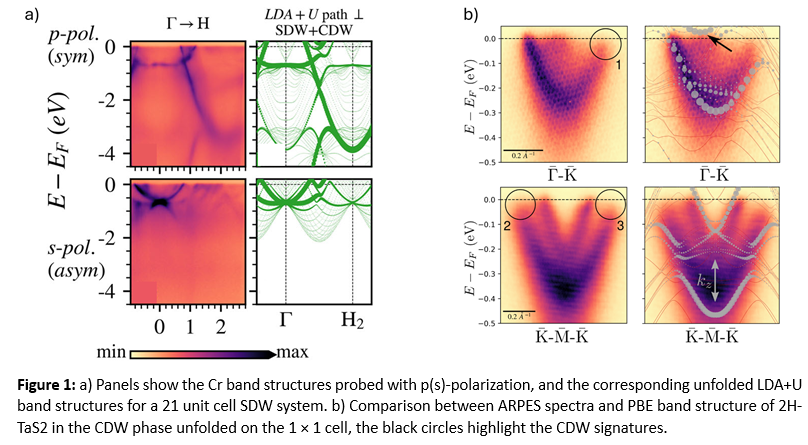
Quantum materials hosting charge and spin density waves often exhibit complex photoemission signatures. These signatures are shaped not only by the materials’ intrinsic electronic structures, but also by interference effects coming from the symmetry properties of the lattices. In this talk, it will be shown the angle-resolved photoemission spectroscopy (ARPES) study of two systems: elemental chromium, which has prototypical incommensurate spin and charge density waves (SDW and CDW) [1], and the layered dichalcogenide 2H-TaS₂, in which hidden electronic states emerge due to interlayer quantum interference [2]. Regarding chromium, it will be demonstrated that the interplay between SDW/CDW order and multiple scattering in the final states of photoemission requires a sophisticated theoretical approach to align with experimental data. For 2H-TaS₂, it will be identified the phase-dependent spectral features tied to the CDW transition. In addition, it will be demonstrated how interference between wave functions from nonequivalent layers can suppress or reveal specific electronic states. These findings underline the necessity of moving beyond simplistic models when interpreting ARPES spectra and provide deeper insight into the interconnected roles of electronic correlations, structural periodicity, and final-state effects in complex materials.
[1] F. Bisti, P. Settembri, J. Minár, V.A. Rogalev, R. Widmer, O. Gröning, M. Shi, T. Schmitt, G. Profeta, V.N. Strocov, Communications Materials, 6 (2025) 70 [2] L. Camerano, D. Mastrippolito, D. Pierucci, J. Dai, M. Tallarida, L. Ottaviano, G. Profeta, F. Bisti, Physical Review B, 111 (2025) L121112